
Youth/High School Soccer
Abington’s Randy Garber wins state title in final game, but his legacy will continue for years to come

Support our coverage of high school soccer by subscribing today.
There are coaches in soccer who teach fundamentals, concepts, and tactics. There are others who are masters of motivation and creating positive team cultures.
Then there is Randy Garber.
An Influencer may not be a strong enough word. A fatherly figure might be closer. A difference-maker might not do him enough justice. He’s more than a mentor. He might even be more than a sage or a guru. And because of the size and reach of his wisdom throughout his teaching and coaching career, his presence may even be spiritual.
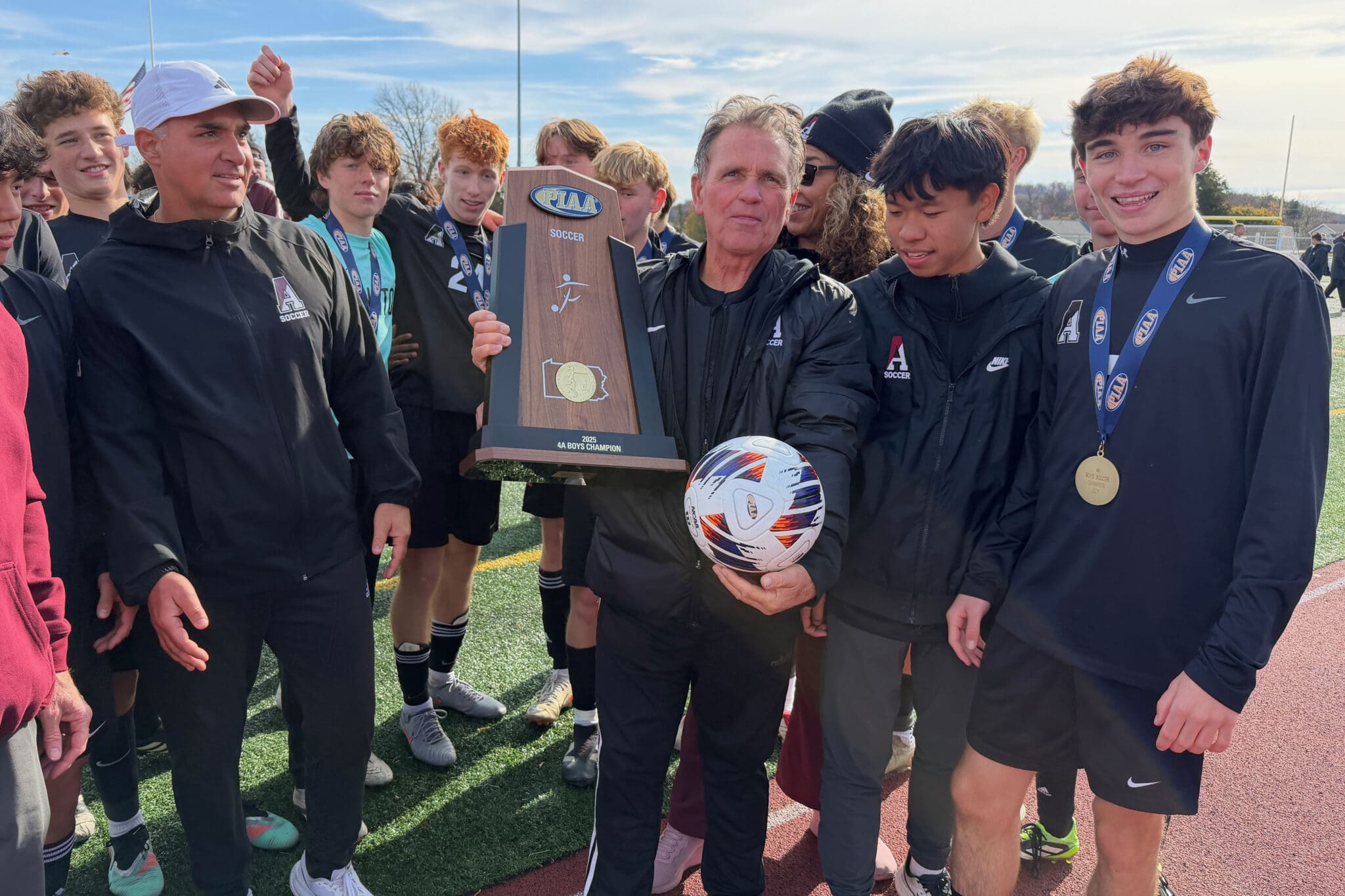
Randy Garber has been one of the most influential people in Southeastern Pennsylvania soccer over the past forty years, and he never needed a state championship to confirm it. But Friday morning at Northeastern High School he did when his Abington squad defeated West Chester Henderson 3-1 to win the PIAA Boys 4A title, only the third state trophy in Abington sports history and the first since 1981.
Abington jumped on their opponents from District One at the start, and first-half goals from Cooper Blynt, Christian Hinkle, and Jaza Vasquez were enough to preserve what had eluded Garber throughout his 32-year coaching career at Abington. They’d been close a few times, most recently reaching the state quarterfinals in 2021 and 2023. In 2012, when his team beat CB East to win the district title, they exited states in the first round.
“It’s tough to reach this point,” Garber told Philadelphia Soccer Now after the game. “Everything has to fall into place. You’ve got to have a good team obviously, but you’ve got to stay healthy, and this year we had a good mix.”
Junior captain Sean Westmoreland controlled the game from his defensive midfield position, setting up the opening goal, and the Ghosts controlled the rest of the game.
“Today was surprising,” Garber added, “because all three goals came during the run of play, which is unusual for us. We usually pinch a goal on a corner kick or throw in and set the tone like we did in the beginning of the states run.”

Garber was already a legend in the Roslyn soccer community before Friday’s win. He graduated from Abington in 1971 and continued his career at Mercer County Community College, earning All-American honors in his first two years. His career continued at Penn State, playing under Herb Schmidt then Walt Bahr, earning Third Team All-American in 1974.
Drafted by the Tampa Bay Rowdies in 1975, Garber won the NASL Soccer Bowl in his first season, and earned his first and only US National Team appearance in a 4-0 loss to Poland.
A year later, he was given the assignment of marking Pele out of the game as the New York Cosmos enigma took the country by storm. His playing career continued for several more years with the Rowdies and Washington Diplomats, playing both indoor and outdoor, and he concluded his career with the Cleveland Force and Philadelphia Fever in the MISL. When his playing days were over, he returned to Penn State to begin his coaching career, studying under Bahr.
Perhaps it was during the time working with Bahr that he began to develop the player-centric style for which he’s most known. Garber’s impact on his players extended beyond the field, and one of his former players holds great appreciation for the support Garber gave him early in his career.
Phil Karn was a senior at Abington in 1993 when Garber was still an assistant under Ken Cooper. While Karn was obliterating school records, scoring 46 of his 90 career goals that year, Garber was running most of the trainings for Cooper, who was nearing his retirement. While Karn’s career was progressing, his connection to Garber remained a personal one.
“He grew up in Roslyn. I grew up in Roslyn,” Karn said when asked about Garber’s impact. “So here’s a guy that played professionally and started coming back into coaching with Rick Tompkins and Billy Tompkins. Just seeing him and his wisdom was something that not everybody gets.”
Karn’s greatest memories were the times he spent with Garber at Marsden Field at Roslyn Park, which is the home field for Roslyn Boys Club, an organization Garber has been involved with for as long as he’s been coaching.
“I used to go there every day to work on my game, and he would come out and cross balls with me and work with me because he could see the field from his house.”
Though Karn also played for Garber in the Inter County Select program and the Olympic Development Program up until he went to college and turned pro, the experience of training with a role model became a unique experience. Karn even recalls in those years Garber was still working a few side jobs, yet he still committed to help whenever possible.
“It was convenient. It worked for him because the field was still there. But he did it. He still stopped what he was doing. That was invaluable, having a guy of his level and stature as a coach, always out there to help you. And not only for me, but he’s done it for so many players over the last 30 years.”
Karn’s 1993 team lost in the district final to Great Valley then reached the quarterfinals at states, which had been a proverbial hump for the Ghosts for several decades until this season. After Abington, Karn scored 25 goals his first two seasons at Drexel before transferring to Penn State, where he led the Big Ten in points in 1996 with 10 goals and 4 assists, finishing his career with 47 collegiate goals. Karn followed his idol to the pros, mostly with the upstart Pittsburgh
Riverhounds, where he became the club’s top scorer in their debut season and the first Hound to score two hat-tricks.
“He was a player’s coach,” Karn said when asked about what makes Garber special. “He had a lot of experience playing the game, and he could relate right away. And he demanded a lot of you. He knew what you were capable of and demanded a lot of you from the sidelines with his voice, to get you motivated, to get you going, to push you, and when you dropped off he noticed it and got on you. And he got on you in the right way. It was a loving way. When a coach is yelling at you, it means he cares, and he cared.”
Karn transitioned into coaching and has been with the Philadelphia Union Academy since its origins. Working with younger teenage players, he gained numerous insights on the value of connecting with players that he’d learned from his mentor.
“The best coaches are the ones that can really get to know the players, know individually what each needs, and to be able to bring that out across an entire team,” he said. “Here [Philadelphia Union Academy], players talk about the coaches they love, and they cared about you as a person. They cared about things off the field. It wasn’t just soccer, soccer, soccer. It was all of it. So when you have that relationship, the players are always willing to do more, because they care so much about the person who cares about them.”

Randy Garber during his playing days with the Tampa Bay Rowdies | Photo via NASLJerseys.com
Now, Karn coaches the Union’s U-14s and leads the Mid-Academy staff and recently saw his former players, Brenden Aaronsen, Mark McKenzie, Matt Freese, and Auston Trusy return to Chester with the U.S. Men’s National Team ahead of their friendly against Paraguay.
“I’ve been able to see it all, so it’s pretty special,” Karn said. “And it all started with Randy and his inspiration to become who I am.”
Karn is still a regular visitor at Garber’s house during holidays and often stops by whenever he visits his parents, who still live in the same Roslyn house in which he grew up.
“My life’s been forever changed because of the direction and guidance I got from Randy in those prime ages.”
# # #
Alan Nichol played for Garber as a select player and has been playing against Garber since the mid-1990s when his Council Rock battled Abington on their way to Rock’s district title in 1992. The head coach at Council Rock South since 2002, Nichol and his teams have played Abington every season, sometimes even clashing in district competition.
“I’m pretty sure when Bob Dylan said, ‘I’ve forgotten more than you’ll ever know’ he was talking about Randy Garber,” Nichol said. “And I’m not just talking about his soccer ingenuity. Randy has impacted countless lives with his passion, dedication, and integrity. I am among those many people who have been inspired by him and continue to be aspire to be like him. Regardless of how the state final went, he was already a champion, and those fortunate enough to know him
are the biggest winners of all.”
# # #
Mike Gorni graduated from Abington in 1976 just as Garber was in the height of his pro career in the NASL. A former NSCAA All-American and All-East Coast Conference player at Temple who ranks tenth all-time in points, Gorni, along with Garber, is one of the most distinguished and respected individuals across the Greater Philadelphia soccer region.
Throughout his coaching career, Gorni took three different FC Delco teams to national finals and did the same while
with Lehigh Valley United and HEX PA Dominion, winning two Maguire Cups (U-19) with LVU. For over two decades, Gorni coached with Garber in the EPYSA ODP program and coached against him while leading CB East.
“He’s done a tremendous job year in and year out,” Gorni said, “loves his players, everybody knows that, and knows the game as well as anybody at all levels.”
Gorni’s East went 26-0 to claim the PIAA State title in 2015, his only state title, though he’s had several good teams come close, so he was aware of what Garber was going through this season while on the cusp. “A heck of a lot of people were pulling for him and his team. It seemed like they’re very enthusiastic and moved forward in a great way this year, and no one is more deserving of getting this championship than Randy is.”
While the allure of club competition has taken some of the area’s best players away from school soccer, it’s unique seeing established coaches like Garber and Gorni remain in it for as long as they did.
“High school soccer is still very community based, so you get a really nice following,” Gorni said. “Each class that comes in is a little bit different, so it’s interesting, and Randy’s been able to not only manage that but keep producing quality teams year after year.”
Since 2015, Abington has been to districts nine years out of ten, continuing a winning tradition that goes back to Garber and Gorni’s playing days. According to Gorni, much of that has to do with Garber’s ability to create cohesion.
“Randy’s greatest gift is assembling the individual players and making them believe they can be successful together. He’s a mixture of calm and very committed and emotional, and he keeps them all in check.”
Gorni also pointed out the large number of alumni Garber has on his staff as well as the strong following of alumni support as evidence of his lasting impact on his players.
“I went to a game recently, and there were probably ten to twenty guys and families there, and everyone was from a different class, so you have guys going back between thirty and seventy years old, and that’s probably rare.”
In 2012, Gorni’s CB East met Abington in the district final, with Abington winning 3-1 to claim Garber’s lone district title despite reaching the final game in multiple seasons. Abington had most recently reached the 2023 final, falling to Conestoga. Two Abington greats coaching against each other in a district final didn’t detract from what the game really meant for both men.
“We’ve coached against so many of our good friends, and like we’d tell the kids compete between the lines, and after the game you’re friends, you’re family.”
# # #
Eric McAnena played for Garber at Abington from 2008-2010.
“He was so low pressure,” McAnena said about Garber, “loved soccer, loves the team aspect. He wasn’t the drill sergeant coach. Just a laid back, reserved guy. I had him in PE class as well, and he had the same reputation. I love that about him, a humble guy. You would never know he was such a talented player.”
McAnena was a Suburban One All-League player for Abington and later had a four-year career at Wilkes, where he earned All-Freedom honors his junior year. He noted how Garber was always willing to help his players beyond Abington.
“I remember he was super open about, if you want to go to the next level, talk to him, use his network. I wasn’t sure what I was going to do, but he was always open about that, willing to help and have a conversation, very approachable.”
# # #
Matt Sirolli is one of those Abington alumni currently helping Garber on the sidelines. Sirolli played for Garber from 1995-1997 before his career took him to Villanova and Penn State. Since 2011, he’s been the Director of the Futures Playing Academy and has also coached for Lehigh Valley United, HEX, Delaware Valley University, and most recently was named Director of Coaching at Boyertown Soccer Club.
“He was just so honest and real with you as a player,” Sirolli said about playing for Garber. “He told you what you needed to do to get better, and for me, as an attacking player, it was the little nuances of the game he’d always help me with.”
Sirolli scored 30 goals and added 24 assists in his three years at Abington, earning All-League and All-Area honors multiple years. “He was hard on us, but you knew he loved you. Teaching us those traits, those characteristics of how to be better, how to train properly, that was the biggest thing for me.”
Garber also used his connections help Sirolli gauge the college landscape. “He was always so in touch back then with the club setting, with ODP, with college coaches, and gave me advice that I now use to give my kids today.”
One of Sirolli’s biggest takeaways from coaching with Garber now is his emphasis on his own team rather than on the opposition. “He really doesn’t believe in scouting the other teams,” Sirolli said. “Obviously, he’s won so many games, he gets his team prepared to play the way he sees fit, with the best players in his system.”
Sirolli compares Garber’s training philosophies to Gorni’s in that both coaches focus on playing to their highest level, with functional training and attention to details, especially on set pieces. Much like those before him, Sirolli credits Garber’s communication as a defining characteristic of his coaching.
“He’s so great at coaching different players,” he said. “He knows the right way to talk to different kids, kids he could yell at, kids he couldn’t yell at, that’s what made him a special coach.”
Sirolli, who currently lives in Lake Harmony and commutes to the area to coach, often finds himself at Garber’s house, catching up on the game and other aspects of life off the field. He credits Garber’s open door, whether hosting film sessions at his house or keeping his gym office door open for players and students to talk, as keys to developing those communication channels. All of this creates a family atmosphere, which is something Garber wanted. One of the eight alumni assistants, Mick Depace, grew up with Garber in the same neighborhood and played with him at Abington.
# # #
Though Garber will continue to be a Roslyn and Abington icon for many years to come, his guidance was not limited to school and townships lines.
I went to William Tennent and played against Garber for four years, back when Abington and Tennent were in the same division. I also played for him with the ODP program from age sixteen to eighteen and later with the U-23s. I first played for Garber after my junior year in high school, when his Abington team eliminated ours from playoff contention on the final day of the season. The following spring and summer I competed with the likes of Chris Albright (Virginia), Jim Curtin (Villanova), Ryan Trout (Virginia), Raymie Marchak (Rhode Island), Sean Kelty (St. Bonaventure), Pete Shellenberger (Penn State), Kevin Griffin (Princeton), all top players among a player pool of close to forty who went on to play at Division 1 schools. I spent a summer trying to crack the starting XI but had earned only enough time to make small contributions.
That fall, I tore my meniscus five games into the high school season and missed six months while it healed, a devastating injury for a 17-year-old. It had an impact on my college recruiting, and though I missed all the ODP tryouts and mini camps, Garber told me to focus on my rehab. He’d keep a spot open for me. That spring and summer, I fought hard to get back to where I’d been, but when I went for my first year at Penn State I was still behind. I had to walk on in the
spring, mostly because many seniors like Karn were graduating, and they needed bodies to fill trainings.
The next summer, I returned home with few options. There was no PDL, no USL-2, no NPSL. I had my pick of the Danubia and Jeffersonville adult summer leagues. Garber let me play with ODP U-18s for the summer, so I could train with high level players. Though they were mostly high school seniors preparing for their freshman years in college, I still fell within the age category.
I remember distinctly playing a game at regionals and noticing Penn State assistant Aidan Heaney watching our game. Garber left the bench and walked around to the far side of the field to talk to him while Rick Tompkins took over. While playing, I watched Garber talk to Heaney for almost twenty minutes.
My spot at Penn State was not a given. I wasn’t on a scholarship. I had to fight my way in. That season, I started almost every game, and we lost to national champion Indiana in overtime in the Big Ten Finals but knocked off UConn in the first round of NCAAs. At some point, during the season, my coach told me how Garber had vouched for me during their lengthy conversation.
Those two examples alone are why I will always remember Garber. Like Karn had said, he didn’t need to do those things. Soccer is a competitive sport. Injuries happen. Players don’t make teams. But he went out of his way to fight for me, to boost my career, and thirty years later I’m still grateful for his presence in my life.
# # #
Ryan Haney was in a similar situation that summer. After scoring 13 goals his freshman season at Temple, he was in the middle of a transfer to Rider. Haney had been an All-Catholic League player at Archbishop Ryan, where he’s guided the boy’s program since 2016. He previously coached the girls team for almost a decade before switching to the boys.
“He still calls me Magic,” Haney said, whenever Garber sees him. The nickname goes back to ODP regionals when Haney had multiple-goal games, including a hat-trick in the regional final to lead Eastern Pennsylvania to the title.
This season, Abington beat Ryan 3-0 in August, only a week after Abington dropped the season opener to Haverford, who handed Abington their only two losses of the season, with the other coming in the district final.
“I’ve always stayed close with him throughout my adult life,” Haney said. In particular, Haney remembers Garber visiting him in the hospital after a bad car accident in his late twenties as well as guiding him years later. “When I got on the boys side, he was one of the first coaches who said, we’re playing each other, so I’ve been playing him for a while every year.”
Haney’s first experience playing for Garber came during his junior year at Ryan. He went into the ODP pool not knowing what to expect from Garber, yet he knew right away he’d found his coach. “When you get to play for him, I remember, I was going through a brick wall for him. The way he made you feel, I would give everything I could.”
During one game in particular, Haney pretty much did that. He was on the bench during a game in which an opposing player made a snarky comment back toward Garber after the coach had complained to the referee about a challenge. Haney later went into the game and wrecked the kid. And though Garber was never the type to condone unsportsmanlike play or dirty challenges, Haney certainly left an impression.
“He never quit on me,” Haney said, “which is why I think a lot of his players have that respect for him. He gives that feeling from day one that I believe in you, I’m going to be there for you.”
# # #
If there’s one coach who’s made the biggest impact on the game of soccer in the Philadelphia area, it’s Jim Curtin. The 11-year coach for the Philadelphia Union coached in four Cup finals, two Concacaf Cup semifinals, and won the Supporters’ Shield in 2020. The two-time MLS Coach of the Year also played for Garber during his time with the ODP program and competed against Abington while a player for Bishop McDevitt.
“I was kind of a late developer,” Curtin said about his early days with Garber, “and I wasn’t always the kid picked for all the state teams for a while growing up. Then, between him and Larry Sullivan, they kind of saw something a little different. Randy was a guy that gave everyone a fair chance. Even at the youth level, there was always a lot of politics around soccer, and he called upon players to come together and see the whole team aspect.”
Curtin played for Garber for two years, and as he grew physically in size and stature, switching from a midfielder to a center back, his level of play also jumped, and he soon became a regular in regional pools, on the verge of a youth national team call-up. But the future Villanova grad was subconsciously taking notes.
“Randy was always a manager and a coach, who in the moments I played for him, didn’t realize all the lessons I’d learned from him that I ended up using as a coach myself. He recognized that each kid came from a different background, and he had a great relationship with every player. To be able to see what motivated each individual player then put the team first, he was incredible at that. I stole a lot of his ideas in the way he coached and dealt with players to kind of come together and win games. And we didn’t lose a lot. We had some great teams.”
Curtin’s career eventually exploded in college, becoming an All-Big East performer in multiple years. The Wildcats’ first-ever MLS Draft Pick in 2001, he went on to win the Supporters’ Shield and multiple U.S. Open Cups with the Chicago Fire, and made an MLS All-Star appearance in 2004, capping one of the most successful careers among local players. The shy, quiet kid from Oreland only needed a push.
“You didn’t want to let him down, which in a lot of ways is so much more powerful than tactics, team shape, all these different things. And he was great at that, too, but he had this way of almost like a father figure for players that you don’t want to disappoint him, so you give so much extra on the field for him, and that’s why he’s had so much success for so many years.”
Curtin himself has built a reputation over the years for developing strong relationships with his players, other coaches, fans, and media. Like Garber, his public and personal personas are the same. He coaches from the heart but is just as competitive as the next coach. When he had the opportunity to spend a week observing Liverpool and Jurgen Klopp, he noticed similar patterns.
“The game kind of universally goes back to relationships and how you treat people and how you motivate people and motivate players and your staff and all that. And Randy is an expert in that.”
# # #

Garber will now be passing on the head coaching duties to his former player, Isaac Pitkow, who played for Garber from 2008 to 2011 before a successful four-year career at Dickinson. Pitkow currently teaches at Abington in the Health and Physical Education department, which ensures the stability in the program continues from when Garber took over for Cooper over three decades ago. He will be the fifth boys coach in the program’s history.
“We created an environment for the players that played for me that they wanted to come back,” Garber said.
Garber, as always, is too humble to say it, so I will. The players come back because of the way he’s coached them, because of the way he’s made them feel.
Though Garber may no longer hold the official position of coach, it’s likely he’ll still be involved in some capacity. After creating a culture of family within the Abington community and beyond for decades, his presence will be missed, but his legacy will outlast him. The soccer community is a tight one, and chances are Garber’s impact has reached the thousands, maybe even the tens of thousands. And in capturing only some of their stories, one can predict there are many more players and coaches whose lives have been touched by the generosity and care from a single man, who just so happened to coach soccer.