International Soccer
Finding meaning in Philadelphia’s FIFA World Cup Fan Fest

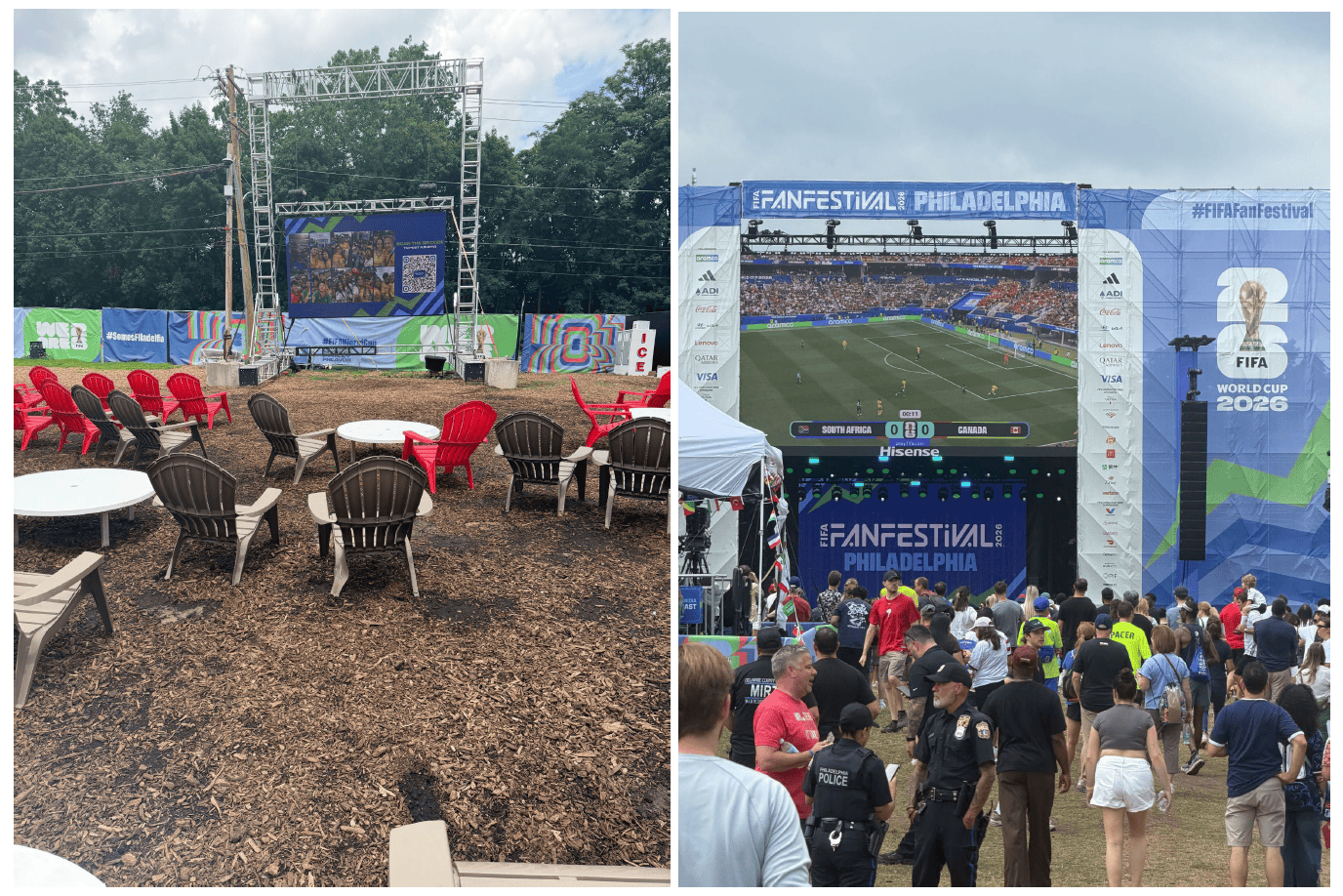
On Sunday, June 28th, I attended Philadelphia’s World Cup Fan Fest in Lemon Hill Park – for Canada vs. South Africa. I was wowed by much of it, and it was a sign of monumental progress for soccer in the city.
First, the facts, and then what they mean.
The necessities were there – guest services, water stations, charging stations, seating, and port-a-potties were scattered throughout the park upon entering. There were various local food options, including Philly Pretzel and Pat’s King of Steaks, and fans could try their luck in any one of the soccer activation activities – small-field soccer, World Cup-themed foosball, a passing challenge, “Beckham’s Backyard,” and more. They could also check out the store, which was lined with World Cup merch, soccer balls, team jerseys, and plush mascots.

The store was also lined with abstract art representing Philadelphia.
There were miscellaneous stations to check out – a Visit PA tent, where fans could spin a wheel and win a prize; and a Casamigos-sponsored stand, with the choice of a margarita or spicy margarita in a souvenir cup.
When the game started, there was ample seating and standing room to watch the game on either side of the fan fest, on stage-sized screens.


Philadelphia’s fan fest and fan fests across host cities have done what isn’t always capitalized on in the U.S.: connect with the people living in their cities or give international fans a taste of the cities they’re in. Young fans were smiling from ear to ear after experiencing one of the soccer activation stations or leaving the store with merch. It’s important to nurture soccer fans from a young age. The local food stands made Philadelphia locals feel at home and allowed international fans to experience the city.
The most important things were executed perfectly – creating a fun, friendly, and culturally rich environment that fostered unforgettable memories and provided a space for people to watch soccer. The strategy: put people, whether they are actually interested in watching the game or not, in a good mood. It might get them to watch a game. It might get them hooked on soccer.
However, not everyone there seemed to know what was going on. It appeared that many people weren’t paying attention to the game on the big screen. I also found myself explaining the offside rule to several people behind me. Regardless, the World Cup is bringing in new fans, which is fantastic. To get everyone else on board, patience is needed. Rome wasn’t built in a day, and soccer won’t become the number one sport here overnight. But know that significant progress has already been made, and soccer is on the rise.
It’s undeniable that soccer in the U.S. has grown rapidly – look at public opinion and what soccer legends have said about it in 2000, 2018, and 2026. Four former players are a small sample size, but they knew it was legitimate and had a future. Even German midfielder Lothar Matthäus was spot on in predicting that Colombian midfielder James Rodríguez (formerly of Minnesota United) would eventually play in Major League Soccer. The right foundations were in place, and the sport has attracted more fans every year. Last year’s Club World Cup and this year’s World Cup are the product of decades of work and fandom.
American soccer and Philadelphia soccer are distinct but complementary. More importantly, each one is a reflection of the other. If soccer culture in Philadelphia is strong, then so is soccer culture across the country, and vice versa. Both are equally important.
Although Philadelphia didn’t host the most important games this summer, the city has been instrumental in getting soccer in the U.S. to the place it is today. Just up the road, Bethlehem is rich in soccer history. Once home of Bethlehem Steel FC, one of the first dynasties and one of the winningest teams in American soccer, it inspired Philadelphia’s MLS team, the Union, to pay homage in the form of branding. Bethlehem Steel folded during the Great Depression, but the Union wore Steel-inspired jerseys in 2013 and renamed their affiliate team for a few years. Goalkeeper Matt Freese, a Philadelphia Union homegrown player born in Wayne, PA, has impressed (but also struggled) for the U.S. Men’s National Team at the World Cup. The USMNT went on a memorable run in this World Cup, and Freese was at the center of it. Not only that, but Brendan Aaronson, Mark McKenzie, and Auston Trusty all came up through the Union academy and made the U.S. World Cup roster, Trusty scoring an unforgettable goal against Turkiye.
Compare then – when the U.S. hosted the World Cup in 1994 – and now, and the progress is remarkable. My brother knows more about the history of soccer than I do, having written Soccer Goes American, and he found that both our first time and second time hosting meant large strides forward. The U.S., after attempting and failing to host the World Cup in 1986, won the bid in 1994 – on the condition that it established a top-flight league after the NASL became defunct. To build on American soccer’s momentum in 1994, the U.S. Soccer Federation marketed the sport as a hot commodity. Thus, the MLS was born.
Today, the same strategy is being used through fan fests, with fans able to “claim” cities (Brazil fans, Philadelphia) and promotions like the Fox One Chief World Cup Watcher. This time around, fans have been more engaged and feel like part of this year’s edition. It was widely known that 1994 and 2026 were golden opportunities to attract internationally established players. That approach has proven to be successful. Soccer Goes American argues that American soccer is expanding beyond its original framework, thereby advancing global and domestic perspectives.
Now, Philadelphia is a host city, and people – both locals and tourists – have been showing up to games, fan fests, and city sights in numbers. We are experiencing and navigating the most important era in American soccer history in one of its most important cities, Philadelphia.
The July 6th defeat to Belgium in the World Cup quarterfinals feels disheartening to soccer fans because they fear this performance means soccer will never truly capture the hearts of Americans and leave a poor impression on the rest of the world. These fears are real, and we are actively seeing people immediately change focus to baseball and soon to football. The pain of this loss will always be there, and it isn’t just one player’s fault – the whole team didn’t look as dangerous or as focused as they had in the four previous games. The future is bright, though. This golden generation isn’t over yet, and there is talent beyond it; domestic youth academies are flooded with talent, and more youth players are going abroad. The three players who are pivotal to this USMNT squad – Balogun (Arsenal), Christian Pulisic (Dortmund), and Malik Tillman (Leverkusen) – all developed in European academies. It can be done again, and “starting over” shouldn’t feel like starting over; this was a learning moment for everyone and doesn’t erase any of the progress made.
American soccer culture still has room to grow, but what we have lived through this summer is not only exciting and engaging – it’s a good sign. As signs around the fan fest read, “We’re making history, as usual.”