
Philadelphia Union
Uhre and Iloski provided spark to break through Fire’s wall

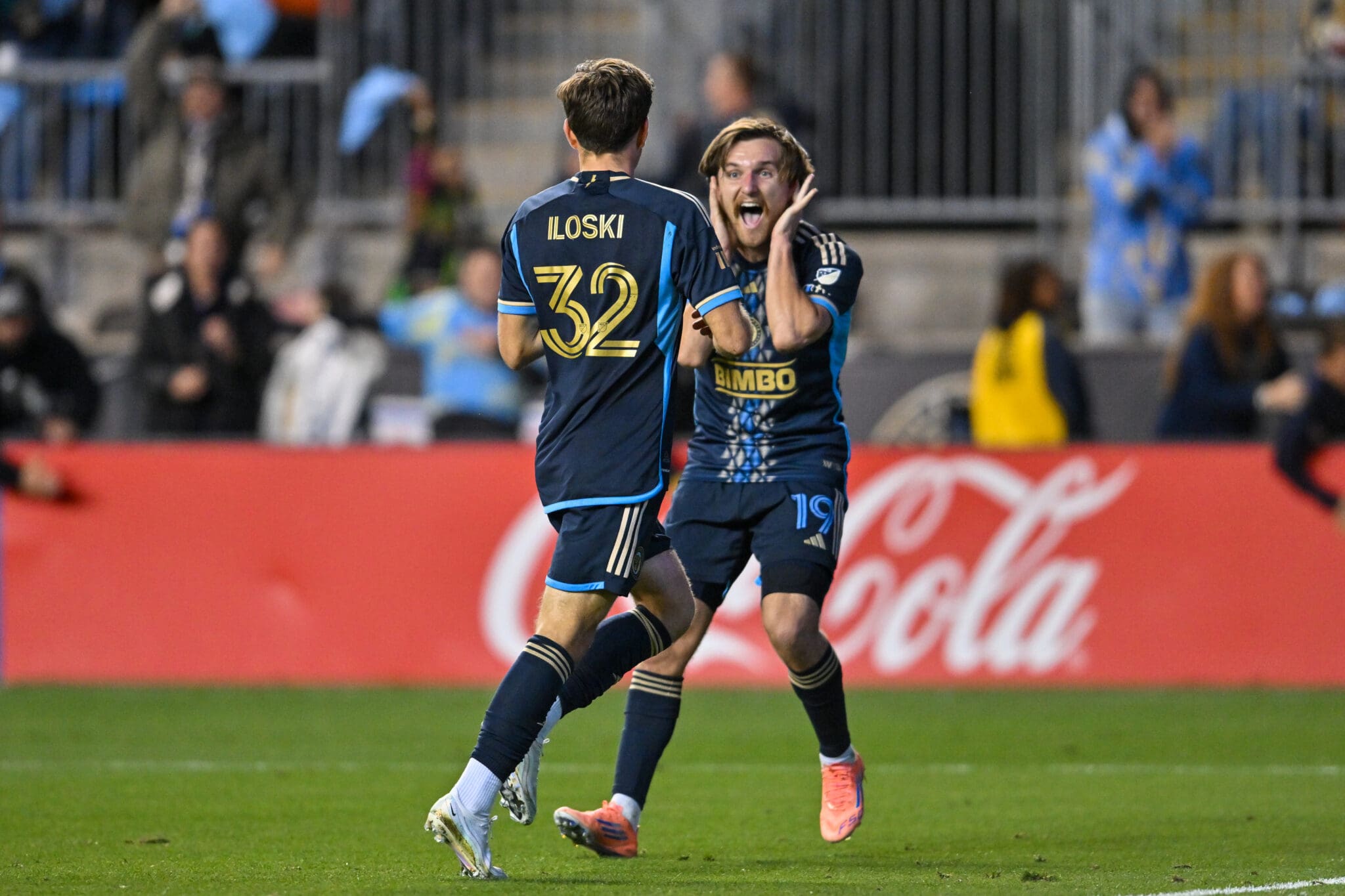
The Chicago Fire entered Game 1 of the Eastern Conference quarterfinals against the Philadelphia Union with a simple game plan.
Deny, Delay, Delete.
Deny goalscoring opportunities. Delay the game as much as agonizingly possible. Delete the Union press by making them possess the ball and penetrate their wall. For much of the game, Gregg Berhalter’s strategy worked.
Enter Mikael Uhre.
In the 64th minute, the Union’s DP striker subbed in alongside Frankie Westfield. Up until then, their teammates, Bruno Damiani and Nathan Harriel had worked hard wearing down their counterparts but had been largely ineffective going forward. Now with fresh legs and an attacking mindset, Union coach Bradley Carnell had the mismatch he wanted down the right side with Uhre and Westfield joining striker Milan Iloski to create counter moments. And according to Carnell, all his team needed was time.
“We’ve seen all season long they’ve given up goals late, right?” Carnell said while addressing the media after the game. “They started to get a little bit more forward with their outside backs. Those were some areas we could exploit.”
The Chicago Fire conceded 60 goals in the regular season. 37 (62%) have come in the second half and 22 (37%) have come after the 60 th minute. In the Union’s 4-0 win over the Fire on August 23 rd , the Union scored three of their four goals after the 60 th minute.
“When the opposition’s legs get tried, then Mikael comes in and creates a difference because he’s just running off the ball.”
Six minutes after Uhre appeared, the Union found the moment they needed.
When Jovan Lukic won the ball deep in the Union’s half and found Iloski out wide, Fire wing back Andrew Gutman had been caught upfield after making a full field sprint down the flank without any service. The moment created an imbalance for the Fire back five. With Uhre one- on-one in space, he cut Fire center back Jack Elliott inside and picked out Indiana Vassilev’s late run at the far post. Vassilev still had to work with a tight angle, but he settled the ball off his chest and kept his shot low to beat keeper Chris Brady for the 1-0 lead.
“I was just trying to find some space and get out running as I obviously like,” Uhre said after the game about the first Union goal, “and it worked out pretty well on the goal from Indy.”
Though Uhre has not received a bulk of the starts in recent games, he’s been effective as of late in a super-sub role. Four of Uhre’s six goals and four of his seven assists this season have come off the bench. He had a goal and two assists in the Union’s 6-0 drubbing of DC United September 27th after subbing in early in the game when Quinn Sullivan went down for the season with a knee injury. In the last four games, he’s contributed two goals and three assists as a reserve. Sunday night, however, he found an opportunistic moment to run at his former teammate, Elliott.
“Obviously I played with Jack a lot of times, so he probably knows that normally I would go on my right, so I was thinking, let me cut it in and see how it opens up. Then I could see Indy making the run on the back post.”
“He just gives us a little bit of a different look,” Vassilev said about Uhre’s contribution to the game. “Everyone gives us the option behind. He’s just much quicker, so he latches onto a lot more of them, and their defense is more weary of him behind.”
Vassilev also credits the Union’s ability to create constant pressure, something Carnell calls “chaotic moments,” which began to materialize more late in the game.
“It’s tough to go 0-0 against our team so far into the match,” Vassilev said. “Pressure is going to continue to come. We want to put teams under pressure. We’re going to continue to do it for 90 minutes.”
It only took the Union five minutes to create another moment and double their lead. And the second goal, despite the end result being much different, developed in the exact same way. Once again, the Union forced a turnover inside their own half and broke free down the right side with the Fire wingbacks caught up too far. This time, a Lukic entry ball to Tai Baribo led to Iloski in space down the right side. Taking on Elliot one-on-one, Iloski cut inside and buried a shot into the far top corner that Brady had no chance stopping.
“As I was dribbling forward, I noticed there wasn’t a lot of options,” Iloski said after the game about the build-up play. “The other center back was in a good position, so I knew off the dribble I could beat him [Elliot] easily, so once he got close, I had to get the ball out of my feet and put it on target.”
Iloski, who joined the Union in July from FC Nordsjaelland, scored his 4th goal for the Union in all competitions, yet he’s been scoring all season. He spent the first half of the season with San Diego and went on a tear, scoring ten goals in fourteen games for the Western Conference leaders. The reserve striker, turned wide midfielder due the previously mentioned injury to
Sullivan, has added another dimension to the Union attack with his natural instincts for the goal and an incredible ball-striking ability.
Despite the two-goal cushion, the Union conceded twice in the final ten minutes, setting up a dramatic penalty shootout. Illoski stuck his penalty into the top right corner to put the Union up 1-0 in the shootout after Uhre missed his opening penalty. Brady guessed right on Uhre’s, getting a bottom hand on the ball to keep it out, but the Fire keeper had no chance on Iloski’s going the wrong way. The Union went on to win 4-2 on penalties after Jesus Bueno slotted home the winner.
“It was a great win. Great for the team, great for the city,” Iloski said. “We wanted to win at all costs. Maybe it wasn’t the prettiest at the end, but we’ll take it.”
In Game 2 Saturday night in Chicago, the Union will likely expect the same strategy. The Fire will be content to make the game as boring as possible, and it will be up to the Union to break down an organized opponent with patience and skill.